

2025 Remodel Challenges: Hidden Costs That Demand Early Budgeting
A recent HomeAdvisor survey indicates that 42 percent of homeowners experience renovation costs surpassing initial estimates. The National Association of Home Builders reports that unforeseen expenses represent about 18 percent of total remodeling budgets. These statistics underscore a key reality in home improvement: concealed costs threaten even well-planned projects.
A remodel functions as both a creative endeavor and a financial undertaking. It demands meticulous preparation, ongoing monitoring, and expert guidance. Savvy homeowners adopt a budget-centric approach from the outset, preparing for potential increases before any work commences.
1. Pinpointing the Issue: Sources of Hidden Costs
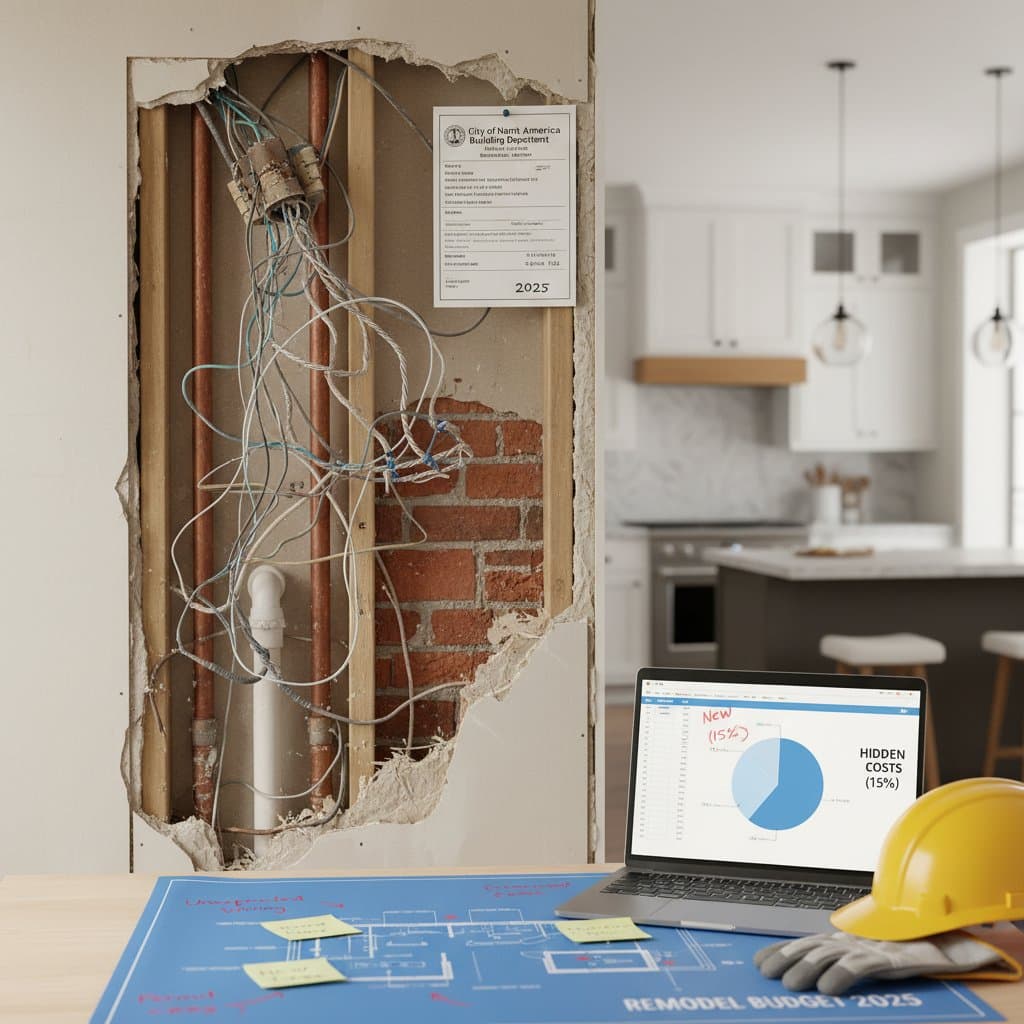
Hidden costs emerge when initial assumptions prove inaccurate. Common culprits include hidden structural flaws, obsolete electrical systems, and aging plumbing. Demolition often reveals these problems, shifting from optimistic forecasts to tangible realities.
Sarah Whitmore, a certified construction cost consultant at Whitmore Project Advisory, notes, "The majority of budget overruns come from incomplete pre-demolition inspections. Homeowners underestimate what lies behind the walls." With more than fifteen years in residential project management, Whitmore advises reserving ten to fifteen percent of the overall budget for unforeseen issues.
Permits, waste removal, and compliance upgrades also produce surprise charges. Local regulations may evolve between approval and execution. New energy efficiency rules or seismic requirements can inflate a standard remodel by thousands of dollars.
2. Expert Perspective: Breaking Down Cost Allocation
Remodeling projects encompass interconnected expense areas. While labor, materials, and design fees form the core, ancillary elements frequently cause the greatest irritation.
- Permit and inspection fees: These range from several hundred to thousands of dollars, depending on location.
- Waste disposal and site cleanup: Rentals for dumpsters and debris removal contribute one to three percent of total expenses.
- Temporary relocation: Occupants displaced by construction often overlook costs for interim accommodations.
James Ortega, principal estimator at ClearBuild Consulting, observes, "Homeowners focus on visible finishes like tile and cabinetry, but the unseen logistical expenses usually drive cost overruns." His firm analyzes over two hundred remodels each year and finds that logistics account for up to twelve percent of concealed costs.
3. Practical Strategies: Minimizing Financial Risks
Homeowners mitigate surprises through rigorous preparation and clear team interactions.
Step 1: Perform a comprehensive pre-renovation assessment
Engage licensed experts in structural engineering, electrical systems, and plumbing to detect issues prior to teardown. Such insights enable contractors to deliver precise pricing.
Step 2: Insist on itemized proposals
Solicit bids that delineate materials, labor, permits, and allowances for contingencies. This level of detail in contracts averts later disagreements over charges.
Step 3: Establish a contingency fund
Financial advisors suggest allocating fifteen to twenty percent of the total budget for unanticipated discoveries. View this reserve as essential operating capital rather than discretionary funds.
Step 4: Apply value engineering techniques
Partner with designers and builders to identify efficient substitutes that preserve performance and aesthetics. For instance, opting for engineered wood flooring instead of solid hardwood reduces costs by thirty percent with little quality loss.
4. Financial Insights: Interpreting Real-World Figures
Remodeling Magazine's Cost vs. Value report shows midrange kitchen renovations averaging over $75,000, with upscale bathroom projects nearing $40,000. These baselines omit many latent factors that escalate totals.
Rewiring electrical systems adds $3,000 to $10,000 based on the property's age. Relocating a load-bearing wall incurs at least $5,000 in structural modifications. Remedying water damage post-demolition ranges from $2,000 to $8,000. Planners rarely anticipate these during preliminary stages.
Laura Chen, senior project accountant at MetroBuild Financial Services, emphasizes, "Budgeting for probable overages should not be viewed as pessimism. It is financial realism. When homeowners plan for contingencies, they maintain control rather than react to emergencies."
5. Assembling a Trusted Team: Essential Professional Support
Partnering with credentialed experts curbs exposure to risks. Verify contractor licenses, insurance coverage, and client references from recent jobs. For larger scopes, appoint a certified project manager to oversee timelines and expenditures.
Organizations like the National Association of the Remodeling Industry (NARI) and the American Institute of Constructors (AIC) offer directories of vetted specialists. These directories connect homeowners with professionals skilled in both building practices and fiscal discipline.
6. Safeguarding Long-Term Value
Post-renovation, diligent record-keeping sustains your investment. Compile warranties for all products, routine maintenance plans, and contractor details. These documents enhance property resale potential and minimize upcoming repair outlays.
Allocate one to two percent of your home's value annually to a maintenance fund. This provision absorbs routine needs and halts neglect that could spawn future concealed expenses.
Effective remodels hinge on fiscal oversight more than aesthetic innovation. Homeowners succeed by monitoring expenditures closely, preparing for deviations, and selecting teams committed to transparent pricing.
As Sarah Whitmore concludes, "A remodel with a clear financial strategy is not just about creating a new space. It is about protecting one of the largest investments a homeowner will ever make."
Anticipating concealed costs empowers confident renovations, budget adherence, and lasting financial stability.