
2026 Wet Rooms: Open Shower Costs and Design Trends
Wet rooms continue to gain traction in residential design, as evidenced by a surge in searches for curbless shower installations. These barrier-free bathrooms integrate the shower area seamlessly into the overall space, promoting accessibility and a sense of openness. Homeowners appreciate the transition from functional utility to serene, spa-inspired environments that enhance daily routines.
This guide examines current interpretations of wet room designs, typical associated costs, and the factors that influence budgeting decisions. Examples from diverse settings demonstrate how professionals achieve aesthetic appeal while managing expenses. Key elements include flooring choices, drainage systems, and material selections that ensure durability and visual harmony.
Wet rooms suit various home types, from urban apartments to rural retreats. Designers emphasize fluid layouts, ample natural light, and cohesive materials. Common features encompass level-entry showers, linear drains, and subtle enclosures that maintain privacy without obstructing flow. The following six examples highlight innovative approaches that balance form, function, and finances.
1. Urban Edge
In a Chicago loft renovation, Marcel & Co. Design Studio created a wet room enveloped in matte black porcelain tile. A single panel of tempered glass separates the shower from the vanity area, complemented by a floating oak bench that introduces warmth to the scheme.
Materials: Matte black porcelain tile, white oak bench, tempered glass divider.
Design Strategy: Uniform application of dark tones fosters an intimate, enveloping ambiance that contrasts with the loft's exposed brick walls.
Functionality: The bench serves dual purposes as seating and concealed towel storage, optimizing the limited space.
Cost Influence: Porcelain tile installation averages $15 to $25 per square foot, keeping the project under $10,000 for a 50-square-foot area.
Visual Impact: This high-contrast palette transforms the room into a refined urban sanctuary with a contemporary, atmospheric depth.
2. Coastal Serenity
A seaside home in Malibu features a wet room by Pacific Wave Interiors, where large-format white subway tiles line the walls and floor. Frameless glass extends to the ceiling, allowing ocean views to permeate the space.
Materials: White subway tile, chrome fixtures, frameless glass enclosure.
Design Strategy: Light-reflective tiles amplify the sense of expansiveness, while minimal hardware maintains clean lines.
Functionality: The linear drain positioned along the wall ensures efficient water evacuation, supporting a fully open layout.
Cost Influence: Subway tiles cost $5 to $10 per square foot, with glass enclosures adding $1,500 to $3,000; total for 60 square feet ranges from $8,000 to $12,000.
Visual Impact: The airy design evokes a beachside retreat, blending indoor comfort with outdoor tranquility.
3. Nordic Minimal
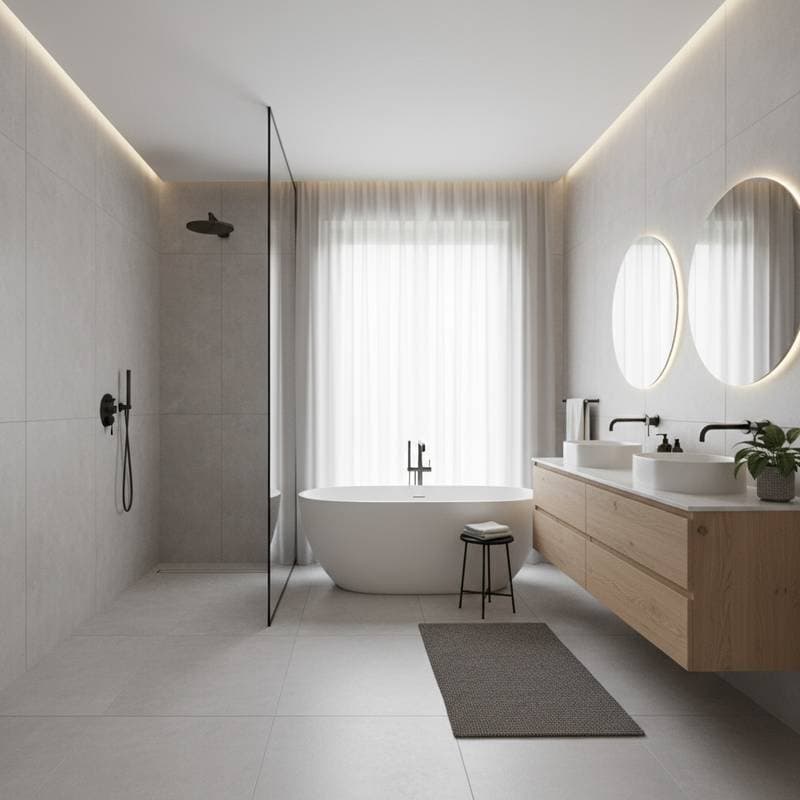
Hansen Form Studio crafted a wet room in a Copenhagen apartment using pale microcement across all surfaces. A recessed wall niche offers discreet storage, enhancing the streamlined profile.
Materials: Pale gray microcement, stainless steel fixtures, frosted glass door.
Design Strategy: Uniform microcement application minimizes visual breaks and streamlines budgeting, as it adheres directly to existing substrates.
Functionality: Subtle floor gradients direct water toward the drain without visible slopes, preserving a flat, accessible surface.
Cost Influence: Microcement application runs $20 to $35 per square foot, resulting in a $9,000 to $15,000 total for compact 40-square-foot spaces.
Visual Impact: Neutral tones distribute light evenly, cultivating a serene environment of understated elegance.
4. Industrial Loft
In a Brooklyn warehouse conversion, Forge Design Group installed a wet room with exposed concrete floors and walls accented by brass hardware. A foldable glass screen provides flexible enclosure options.
Materials: Polished concrete, brass fixtures, foldable glass screen.
Design Strategy: Retaining original concrete reduces material costs while adding authentic texture.
Functionality: The screen folds away for full openness or extends for privacy, adapting to user needs.
Cost Influence: Concrete polishing costs $8 to $15 per square foot, with brass adding $500 to $1,000; overall budget for 55 square feet falls between $7,000 and $11,000.
Visual Impact: Raw elements convey robust character, ideal for creative urban dwellers.
5. Mountain Warmth
Reed & Mason Architecture transformed a tub alcove in an Aspen ski lodge into a wet room clad in natural slate. Cedar beams overhead introduce organic warmth to the stone-dominated palette.
Materials: Natural slate tile, cedar ceiling accents, oil-rubbed bronze fixtures.
Design Strategy: Wooden elements mitigate stone's chill and dampen acoustics, fostering a cozy enclosure.
Functionality: A recessed floor perimeter contains water, obviating additional curbs.
Cost Influence: Slate tiles range from $10 to $20 per square foot, cedar $5 to $10; a 70-square-foot project totals $12,000 to $18,000.
Visual Impact: Textural contrasts mirror the surrounding alpine terrain, creating an immersive natural haven.
6. Suburban Elegance
In a Seattle family home, Evergreen Homes designed a wet room with heated porcelain floors and a teak wood accent wall. Low-profile partitions maintain sightlines to the garden.
Materials: Heated porcelain tile, teak wood accents, low-profile glass partitions.
Design Strategy: Heating elements enhance comfort, paired with wood for tactile appeal.
Functionality: Partitions allow wheelchair access while containing splashes.
Cost Influence: Heated floors add $10 to $15 per square foot to porcelain's $10 to $20 base; 65-square-foot totals reach $15,000 to $20,000.
Visual Impact: Balanced materials yield a welcoming, adaptable space for multigenerational use.
Strategies for Budget Management
Achieving a wet room's aesthetic requires deliberate planning to control expenses. Focus on essential systems first, then layer in decorative elements.
-
Emphasize Waterproofing Foundations: Invest in high-quality membranes and sealants, which cost $2 to $5 per square foot but prevent future leaks and repairs.
-
Select Continuous Surface Materials: Extend one tile type across floors and walls to cut labor by 20 percent, saving $1,000 to $3,000 on installation.
-
Combine High- and Low-Cost Elements: Feature premium backsplash tiles at $30 per square foot alongside standard porcelain at $10 per square foot for visual interest without excess spending.
-
Incorporate Prefabricated Components: Use pre-sloped shower pans at $500 to $1,500, which reduce on-site labor by half compared to custom pours.
-
Minimize Plumbing Relocations: Align the design with existing drains to avoid $2,000 to $5,000 in pipework fees.
-
Schedule Off-Peak Installations: Contractors often discount 10 to 15 percent during slower seasons, trimming overall project costs.
In one residential project, retaining the original plumbing layout while upgrading to a linear drain system contained expenses to $14,000 for a 60-square-foot wet room, delivering custom results on a moderate budget.
Daily Integration and Maintenance
A completed wet room integrates into household routines with effortless grace. The seamless design simplifies cleaning, as water residues wipe away quickly from non-porous surfaces.
Accessibility benefits all users, from children to seniors, with level entries reducing trip hazards. Annual inspections of seals and drains, costing under $200 in professional fees, sustain performance.
Homeowners often report enhanced morning rituals, where open layouts promote relaxation. Over time, additions like adjustable benches adapt the space to evolving needs without major alterations.
Advancing Wet Room Innovations
Designers anticipate further refinements in 2026, including smart waterproofing sensors and eco-friendly resins. These advancements lower long-term costs while elevating sustainability.
By selecting durable materials and efficient layouts, a wet room delivers enduring value. This approach ensures the space remains both visually compelling and practically sound for years ahead.