
Revolutionizing Kitchens: Pantry Wall Innovations in Storage and Design
In a remodeled kitchen, the pantry wall emerges as a central element for both organization and aesthetics. Previously a concealed storage area, it now serves as a defining feature that influences overall functionality. While diverse layouts and materials may seem daunting, effective designs rest on proven architectural principles. The guidelines below translate these principles into actionable steps suitable for any homeowner.
1. Prioritize Reach and Workflow
Challenge: Deep shelves often appear spacious yet result in shadowy corners where items become inaccessible and forgotten.
Background: Homeowners frequently request extensive storage, but poor accessibility renders the space ineffective.
Approach: Limit fixed shelf depth to sixteen inches for easy reach. Incorporate pull-out trays or drawers in lower areas, and install adjustable shelving in taller sections to accommodate evolving requirements.
Specification: Select full-extension hardware capable of supporting at least one hundred pounds to handle dense loads such as canned products or compact appliances.
Advantage: This design promotes efficiency through clear visibility and effortless access, ensuring full utilization of purchases and minimizing accumulated disarray.
2. Incorporate Ventilation and Illumination
Challenge: Dim and poorly ventilated storage fosters odors and hinders organization.
Background: Many treat the pantry wall as a simple enclosure rather than an extension of the kitchen's systems.
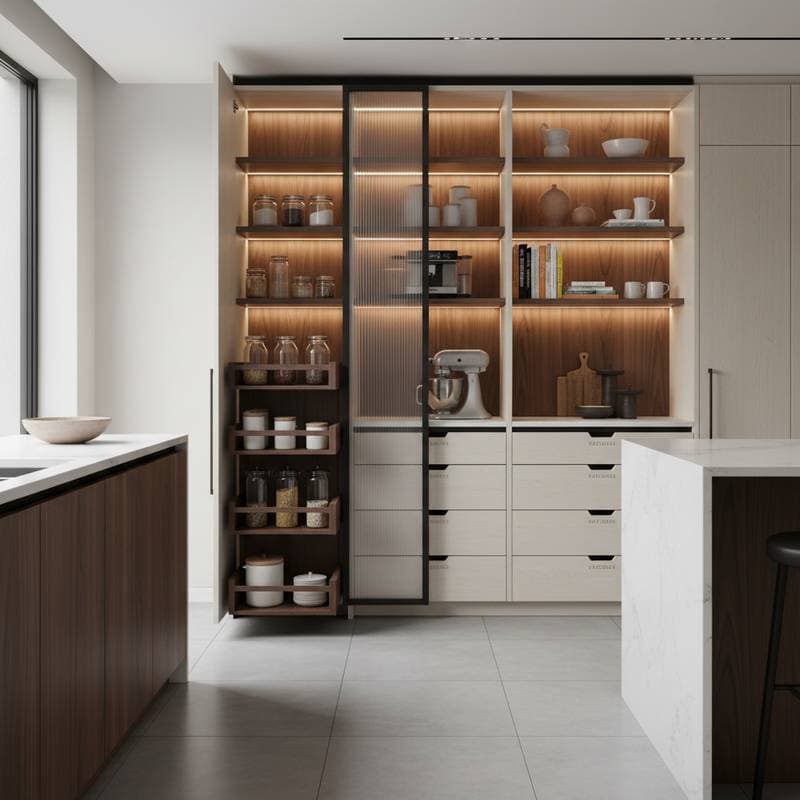
Approach: Install LED strip lights beneath each shelf and integrate a vent or grille linked to the room's air return. Equip with motion sensors to activate lighting upon door opening.
Specification: Opt for a 3000 Kelvin color temperature to deliver warm, effective illumination. Recessed micro fixtures or linear LEDs operate with minimal energy and generate little heat.
Advantage: Proper ventilation and lighting create a thoughtful space akin to the primary cooking zone, enabling rapid location of ingredients without discomfort from glare or confined air.
3. Balance Open and Enclosed Storage
Challenge: Fully open shelving appeals in publications but devolves into disorder in daily practice.
Background: Clients desire showcase-style walls, yet routine use involves assorted containers and bulk items.
Approach: Combine open cubbies for display pieces with enclosed cabinets for everyday essentials. Employ frosted glass or cane inserts to blend the elements seamlessly.
Specification: Fit concealed hinges featuring soft-close mechanisms to avoid distortion. Utilize moisture-resistant MDF or plywood finished with durable paint that aligns with surrounding cabinetry.
Advantage: This hybrid maintains tidiness while providing convenient access, presenting the wall as a cohesive design component rather than a jumble of objects.
4. Designate Appliance Integration Zones
Challenge: Small appliances encroach on countertops due to overlooked internal storage provisions.
Background: Remodels commonly reveal coffee makers, blenders, and toasters dominating preparation areas.
Approach: Allocate a dedicated concealed garage within the wall, complete with internal outlets and roll-up or pocket doors that retract when in use.
Specification: Line the interior counter with heat-resistant laminate or stone to ensure safe operation. Verify electrical circuits accommodate the demands of several devices simultaneously.
Advantage: Concealed yet accessible appliances liberate counter space and uphold visual harmony throughout the kitchen.
5. Select Enduring Materials
Challenge: Fashionable surfaces may succumb rapidly to the rigors of frequent handling.
Background: The pantry wall endures fluctuations in temperature, humidity, and direct contact.
Approach: Favor resilient options such as premium laminates, textured melamine, or sealed wood veneers over untreated timber. For shelves, employ boards resistant to moisture, fully edge-banded.
Specification: Choose low-VOC finishes to safeguard air quality. Satin or matte surfaces conceal fingerprints more effectively than glossy alternatives.
Advantage: Robust materials demand less upkeep and sustain the wall's appeal over time, justifying the initial outlay.
6. Refine Door and Entry Mechanisms
Challenge: Traditional swing doors prove cumbersome on extended walls, particularly in compact kitchens.
Background: Narrow configurations risk obstruction of pathways or interference with adjacent elements.
Approach: Implement sliding, bifold, or pocket doors to conserve space. For full-height installations, adopt vertical track systems for fluid panel movement.
Specification: Equip tracks at top and bottom with soft-close dampers. Select tempered safety glass for inserts to comply with regulations.
Advantage: Streamlined access enhances circulation and imparts a polished, integrated appearance to the wall.
7. Align with Kitchen Operations
Challenge: Isolated pantry designs disrupt the natural progression of cooking activities.
Background: Daily routines involve seamless transitions between refrigerator, sink, preparation surface, and range. Detached placement introduces inefficiency.
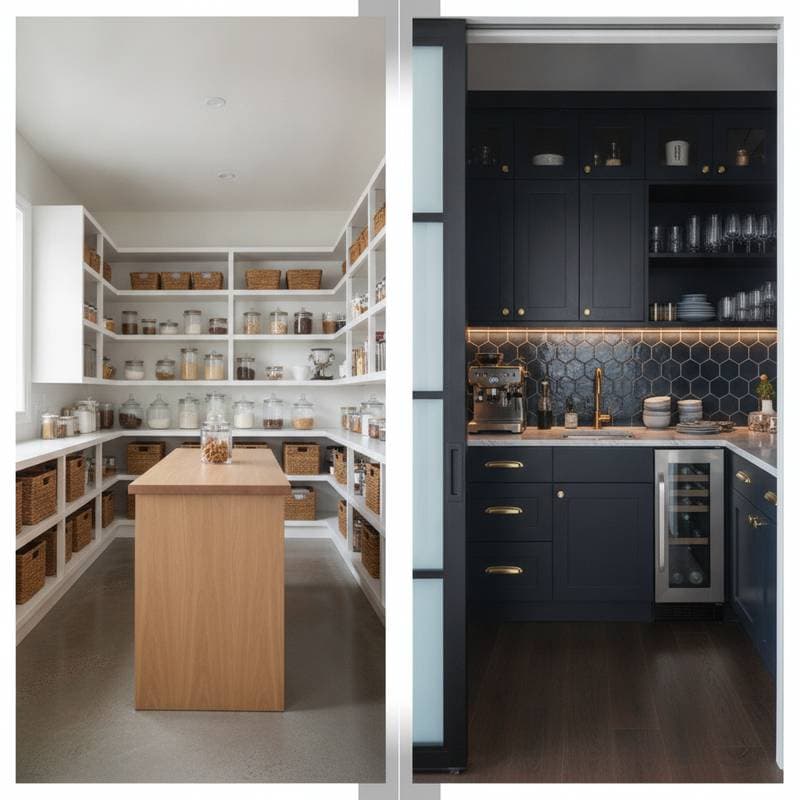
Approach: Locate the pantry adjacent to the refrigerator or prep area for proximity to ingredients. Within walk-in spaces, categorize contents by purpose: baking supplies, snacks, dry staples, and drinks.
Specification: Position pull-out baskets or labeled bins at waist height for frequent items. Place heavy bulk products low and lighter ones higher.
Advantage: Strategic positioning conserves time, eliminates unnecessary steps, and facilitates fluid culinary processes, enhancing overall kitchen usability.
8. Embed Modular Organization Features
Challenge: Unstructured shelves invite rapid accumulation of miscellaneous items.
Background: Users often overlook the pace at which undefined areas become overwhelmed.
Approach: Integrate adjustable systems including bins, dividers, and risers. Modular components permit reconfiguration to match shifting household dynamics.
Specification: Select food-safe plastics or powder-coated metals for straightforward cleaning. Incorporate pull-out wire baskets for fruits and vegetables alongside narrow drawers for packets and spices.
Advantage: Organized categorization fosters clarity, allowing instant inventory assessment to curb waste and excess purchases.
9. Introduce Textural and Chromatic Variety
Challenge: Uniform finishes can render the wall monotonous and uninspired.
Background: Matching the primary cabinetry precisely may diminish visual dynamism.
Approach: Introduce subtle contrasts through textures that enrich without dominating. Pair natural oak with matte black accents or painted sections with rattan weaves for added warmth.
Specification: Harmonize color vibrancy with ambient light levels. In low-light settings, lighter tones amplify brightness. Seal absorbent surfaces against humidity.
Advantage: Intentional variation infuses depth and individuality while upholding practicality, achieving equilibrium in form and function.
10. Ensure Flexibility and Upkeep
Challenge: Static constructions fail to accommodate life's changes, leading to obsolescence.
Background: Household composition, preferences, and routines evolve, rendering inflexible setups inadequate.
Approach: Build in adaptability via adjustable tracks, interchangeable drawer units, and detachable panels. Choose refinishable surfaces to avoid complete overhauls.
Specification: Mount shelves on metal standards adjustable in one-inch intervals. Employ hardware with modular replacements for simplified servicing.
Advantage: Versatile design sustains relevance amid transitions, with routine maintenance remaining straightforward and supportive of ongoing needs.
Enhancing Daily Kitchen Use
After installation, observe the pantry wall in action to identify effective and challenging aspects. Note movement patterns, intuitive elements, and points of irritation. Incremental modifications, such as shelf realignments or bin additions, can optimize performance over time. An effective design adapts to users, promoting sustained utility.
When utility guides the process, aesthetic appeal emerges organically. Superior pantry walls unite resilient construction, rational arrangement, and understated elegance to bolster routine activities. Regardless of kitchen scale, these strategies yield spaces that remain functional, refined, and responsive to future demands.