
2026 Open Shelving: Kitchen Costs and Install Breakdown
Walk into ten renovated kitchens and you will likely see ten different takes on open shelving. Some look clean and intentional, others cluttered and unfinished. The variety proves one truth: open shelving is simple in appearance but complex in execution. The good news is that professional design principles can guide homeowners toward shelves that look beautiful, function well, and hold up over time. Below are ten practical rules drawn from architectural practice that explain what works, what fails, and what it really costs to get it right.
2. Anchor to Structure, Not Just Drywall
Problem: Many floating shelves sag or pull away because they are attached only to drywall anchors.
Context: In one project, a homeowner tried to mount 36-inch walnut shelves on a tiled wall with hollow anchors. Within weeks, the shelf leaned away from the wall under the weight of dishes.
Solution: Secure brackets directly into wall studs or use a continuous cleat system hidden behind the shelf. For masonry walls, use sleeve anchors or toggle bolts rated for the shelf load.
Technical Detail: Each shelf must support roughly 20 to 25 pounds per linear foot. For a 36-inch shelf, this means hardware rated for at least 75 pounds. Always test before loading.
Benefit: Proper anchoring ensures safety, prevents costly repairs, and preserves the clean floating look.
4. Control the Visual Weight
Problem: Open shelving can make a kitchen feel cluttered or heavy if not balanced with surrounding cabinetry.
Context: In a small galley kitchen, too many open shelves above eye level made the space feel top-heavy and crowded.
Solution: Limit open shelves to one or two sections. Keep them near corners or between windows where they appear lighter. Mix with enclosed cabinets to ground the design.
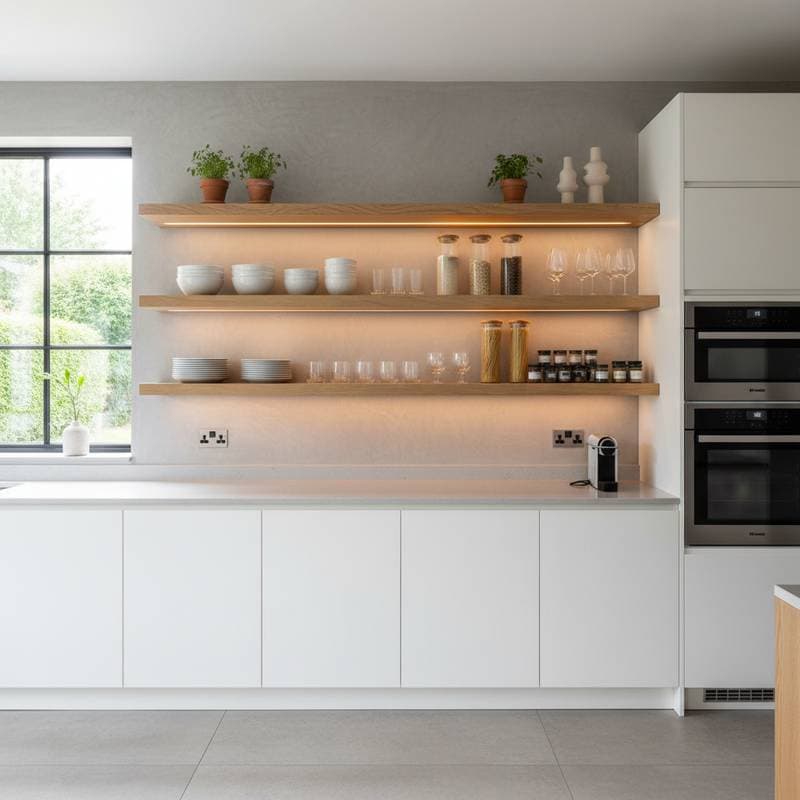
Technical Detail: Maintain a 12- to 15-inch depth for standard shelves and keep shelf thickness between 1 and 1.5 inches to maintain proportion.
Benefit: The kitchen feels open and airy while still providing practical storage.
6. Budget with Real Numbers
Problem: Many homeowners underestimate costs, assuming open shelves are cheaper than cabinets.
Context: Basic floating shelf kits start low, but professional-quality installations add labor, reinforcement, and finishing that quickly raise the price.
Solution: Expect to spend roughly:
- Materials: $35 to $100 per linear foot depending on wood species or metal finish
- Labor: $50 to $100 per hour for carpentry and wall preparation
- Total Installed Cost: $250 to $600 per shelf for custom-built options
Technical Detail: Always include wall repair, painting, and sealing in your quote. Tile backsplash cutting can add another $100 per section.
Benefit: Knowing the full cost upfront prevents surprises and helps you allocate funds for lasting quality instead of quick fixes.
8. Plan for Expansion and Change
Problem: Homeowners often fix shelves permanently, making future modifications difficult.
Context: A family added more cookware later but had no flexibility because their shelves were glued and painted in place.
Solution: Use concealed brackets with removable shelves. This allows easy refinishing or reconfiguration.
Technical Detail: Opt for modular hardware systems with adjustable pins or hidden rails. Leave at least 1/8 inch clearance between shelf and wall for seasonal wood movement.
Benefit: Flexibility ensures your investment adapts to changing needs without full replacement.
10. Connect Style with Structure
Problem: Many designs chase a look without considering the home’s architecture.