2025 Backsplash Costs: Tiles Versus Slabs
The latest Home Improvement Market Index from the National Kitchen and Bath Association reveals that nearly 42 percent of homeowners undertaking kitchen renovations this year express concern over rising material costs. Among these, backsplash selections frequently exceed initial budget projections, ranking within the top five cost overruns. Selecting between tile and slab options profoundly affects initial expenditures as well as ongoing maintenance expenses.
This guide delivers a comprehensive analysis of tile versus slab backsplash finances, incorporating expert perspectives to equip homeowners with realistic budgeting strategies for their projects.
Factors Influencing the Price Difference
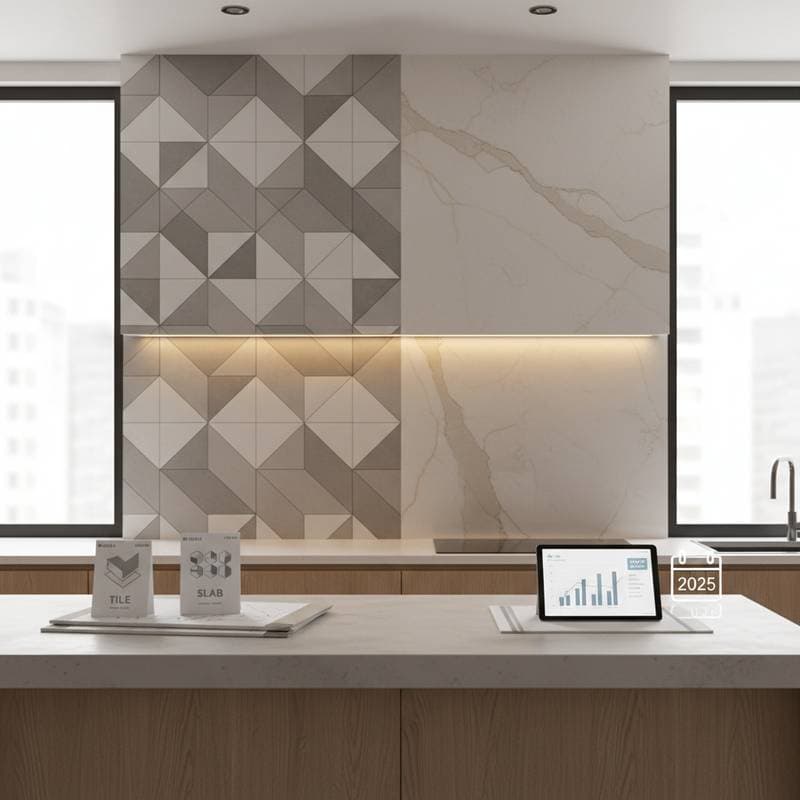
Tile backsplashes prove more economical due to reduced material and production expenses. Installed ceramic and porcelain tiles generally fall between $5 and $25 per square foot. Options such as natural stone or artisanal tiles climb to $40 per square foot. Slab backsplashes, often crafted from quartz, marble, or large-format porcelain, command prices from $70 to $120 per square foot when installed.
Several elements contribute to this disparity:
- Material Procurement: Slabs necessitate expansive, unbroken sheets sourced from premium suppliers, incurring elevated shipping and handling fees.
- Production Expertise: Shaping and polishing slabs requires advanced tools and experienced craftsmen, with processing charges potentially surpassing $1,000 for intricate designs.
- On-Site Assembly: The weight and delicacy of slabs demand multiple installers and specialized lifting gear, complicating the process.
Jamie Luo, a senior project estimator at Buildwise Renovation Group with 18 years of experience, notes, “Homeowners often see slab pricing and forget to factor in delivery, cutouts, and wall prep. Those line items can swing the total cost by 20 percent.”
To budget effectively, calculate square footage first, then add 10 to 15 percent for waste and unforeseen adjustments. Consult local suppliers early to obtain precise quotes, as regional variations in labor and material availability influence final figures.
Detailed Cost Breakdown by Material
Tile Options
Ceramic Tile: Installed costs range from $15 to $30 per square foot. This choice suits economical updates and appeals to those inclined toward self-installation. While fabrication remains straightforward, grout lines demand periodic cleaning to prevent discoloration.
Glass Tile: Expect $30 to $50 per square foot installed. The material imparts a luminous quality, yet its installation involves meticulous cuts, which elevate labor demands.
Natural Stone Tile: Prices span $35 to $60 per square foot. It conveys sophistication, but regular sealing proves essential to guard against moisture and stains.
Slab Options
Quartz Slab: Installed at $80 to $100 per square foot, quartz offers resilience and a consistent appearance, harmonizing seamlessly with matching countertops in contemporary settings.
Marble Slab: Costs reach $100 to $120 per square foot installed. Its elegance comes at the expense of upkeep, as susceptibility to stains and etching may necessitate periodic restoration.
Porcelain Slab: Ranging from $70 to $90 per square foot, this variant weighs less than natural stone alternatives. However, fabricating large panels requires diamond-tipped saws to achieve clean edges.
Carla Mendoza, operations manager at StonePro Fabrication with 22 years in the industry, explains, “Large-format slabs reduce grout maintenance, but they demand perfect wall preparation. If the wall is uneven, labor time doubles.”
For accurate planning, measure your backsplash area precisely and consider patterns or cutouts that could increase material needs. Factor in substrate preparation, such as leveling uneven walls, which adds $5 to $10 per square foot for either option.
Installation Realities and Hidden Expenses
Tile installation typically requires one professional for standard layouts, taking one to two days for a 50-square-foot area. Tools involve basic trowels and spacers, keeping ancillary costs low. Slabs, by comparison, often extend installation to three days or more, with teams handling transport and alignment to avoid cracks.
Hidden fees emerge in both categories. For tiles, mismatched grout colors or pattern layouts might incur rework charges of $200 to $500. Slabs face risks from on-site damage, potentially adding $300 in repairs, plus premiums for custom edging around outlets or sinks.
Homeowners benefit from obtaining multiple bids and verifying installer certifications. Schedule a pre-installation site visit to identify issues like plumbing protrusions that could inflate costs.
Assessing Long-Term Value and Return on Investment
Tiles provide superior value for restrained budgets, enabling diverse designs and simpler updates should preferences evolve. Slabs cater to upscale transformations, enhancing marketability through their fluid aesthetics and robust construction.
Data from the Kitchen Trends Market Study indicates that slab-equipped kitchens recoup approximately 65 percent of backsplash investments upon resale, compared to 55 percent for tile installations. This premium stems from the aura of luxury and perceived longevity.
Apply value engineering by evaluating priorities. Combine a quartz countertop with ceramic tiles to achieve visual cohesion affordably, preserving strong resale potential without excess spending.
Strategies for Sustained Performance
Preserve your backsplash investment through routine care tailored to the material. Tiles benefit from mild soap solutions applied monthly, focusing on grout to deter mold. Slabs require pH-neutral cleaners weekly, avoiding abrasives that dull finishes.
Address issues promptly: reseal stone elements annually and inspect for loose tiles or hairline fractures in slabs. These practices extend durability, minimizing repair budgets over a decade.
By selecting materials aligned with your lifestyle and maintenance capacity, you secure a backsplash that enhances daily use while bolstering your home's enduring appeal.