

Understanding Refacing Versus Replacement in Kitchen Remodels
A national survey by HomeAdvisor reveals that cabinets consume nearly 42 percent of kitchen renovation budgets. However, only 34 percent of homeowners finish their projects within the planned financial limits. These statistics underscore the importance of strategic decisions regarding cabinetry, which influences overall costs, project timelines, and homeowner satisfaction. Homeowners must weigh the benefits of refacing existing cabinets against the advantages of complete replacement to achieve optimal results.
Refacing involves updating the surface appearance of current cabinets by applying new veneers, doors, and hardware, while preserving the underlying structure. Replacement, in contrast, entails removing old cabinets entirely and installing new ones, allowing for changes in layout, materials, and functionality. This guide delivers a thorough analysis of expenses, return on investment, and key considerations to support informed choices.
Cost Breakdown: Refacing and Replacement Options
Expenses for Cabinet Refacing
Refacing generally ranges from $170 to $300 per linear foot, translating to $7,000 to $15,000 for a standard kitchen of approximately 20 to 25 linear feet. Factors such as veneer type, door styles, and hardware selections influence the final price. For instance, a simple laminate refacing project might begin at $6,000, but premium options like solid wood veneers or custom finishes can elevate costs to $20,000 or more.
Professionals recommend assessing the kitchen's size and current condition early. Basic refacing suits smaller spaces or minor updates, whereas extensive customizations demand higher investments. Labor typically accounts for 40 to 50 percent of the total, emphasizing the value of hiring experienced technicians to ensure durability.
Expenses for Full Cabinet Replacement
Replacement costs average $250 to $750 per linear foot, resulting in $15,000 to $45,000 for an average kitchen. Choices in cabinet types—stock, semi-custom, or fully custom—drive much of this variation. Stock options provide affordability for straightforward installations, while custom designs accommodate unique layouts and premium materials.
Additional charges for demolition, wall repairs, and installation can increase the total by $2,000 to $5,000. As noted by Aaron Delgado, project estimator at BuildRight Management Group, homeowners frequently overlook labor expenses. He explains, "Even if materials appear budget-friendly, the time required for removal, structural fixes, and precise installation often boosts the overall cost by 20 percent."
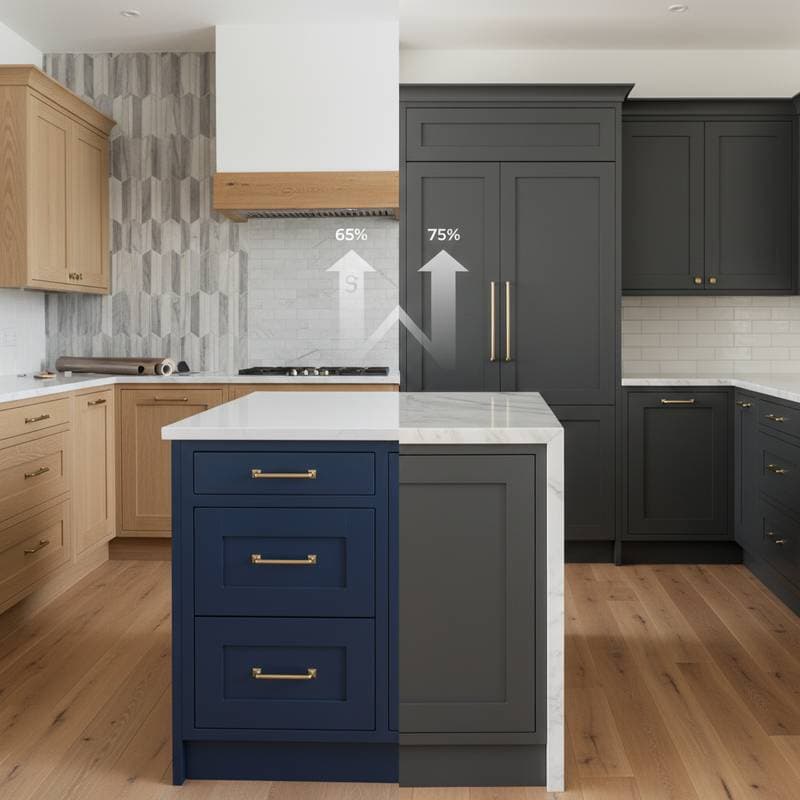
Return on Investment: Refacing at 65 Percent Versus Replacement at 75 Percent
Return on investment serves as a critical metric for evaluating remodel choices, particularly for resale value. Refacing typically yields a 65 percent ROI, meaning a $10,000 project might add about $6,500 to home equity. This approach appeals to those seeking quick, cost-effective enhancements without major disruptions.
Full replacement, however, delivers a higher 75 percent ROI, with a $30,000 investment potentially recouping $22,500 upon selling the home. New cabinets enhance aesthetics, functionality, and perceived quality, attracting buyers in competitive markets. Data from remodeling reports indicate that updated kitchens boost property appeal, especially in homes over 10 years old.
Longevity plays a key role in these figures. Refaced cabinets last 10 to 15 years with proper care, while replacements endure 20 to 30 years, justifying the greater upfront expense for extended ownership.
Uncovering Hidden Costs in Both Approaches
Both refacing and replacement involve potential unforeseen expenses that require careful planning. Awareness of these elements prevents budget overruns and ensures project success.
- Hardware Enhancements: Upgraded hinges, pulls, and soft-close mechanisms add $200 to $800, based on the number of cabinets and material finishes.
- Countertop Adaptations: Structural changes during refacing or replacement may necessitate countertop removal and reinstallation, costing $1,000 to $3,000.
- Utility Updates: Layout shifts can require electrical rewiring or plumbing adjustments to meet building codes, extending labor by several hours and adding $500 to $2,000.
- Debris Management: Disposal of old materials incurs fees of $100 to $400, varying by local waste regulations and volume.
Refacing demands meticulous preparation to prevent issues like veneer adhesion failures, which might lead to repairs within a few years. Replacement mitigates such risks through complete renewal but amplifies initial labor demands. Consulting contractors for a full cost audit early in the process proves essential.
Step-by-Step Framework for Choosing Your Path
Navigating the decision between refacing and replacement benefits from a structured approach. Follow these steps to align your selection with practical and financial goals.
-
Assess Structural Integrity: Examine cabinets for signs of damage, including moisture intrusion, warped frames, or deteriorated interiors. Severe issues necessitate replacement to avoid future complications.
-
Review Current Functionality: Consider workflow efficiency, storage capacity, and accessibility. If the layout hinders daily use, replacement enables reconfiguration for better ergonomics.
-
Project Future Residency and ROI: For stays under five years, refacing maximizes short-term savings. Longer tenures favor replacement for superior durability and higher resale returns.
-
Solicit Multiple Quotes: Obtain detailed proposals from at least two specialists—one for refacing and one for replacement. Verify that estimates cover all labor, materials, and potential add-ons.
-
Allocate a Contingency Budget: Set aside 10 percent of the total estimate for surprises like hidden damage or material price fluctuations. This buffer maintains financial control throughout the remodel.
-
Consult Design Professionals: Engage an interior designer or kitchen planner to visualize outcomes. Their expertise ensures the chosen option enhances overall aesthetics and usability.
Safeguarding Long-Term Value After Installation
Once the project concludes, proactive maintenance extends the lifespan of your investment. Clean cabinets regularly with mild solutions to prevent buildup, and inspect hardware quarterly for wear. Avoid excessive moisture near sinks to protect finishes and structures.
For refaced cabinets, touch up veneers annually to maintain appearance. Replaced units benefit from periodic deep cleaning of interiors to preserve functionality. These habits not only prolong durability but also sustain the strong ROI achieved through thoughtful planning. By integrating care into your routine, you secure lasting enjoyment and financial benefits from your kitchen upgrade.