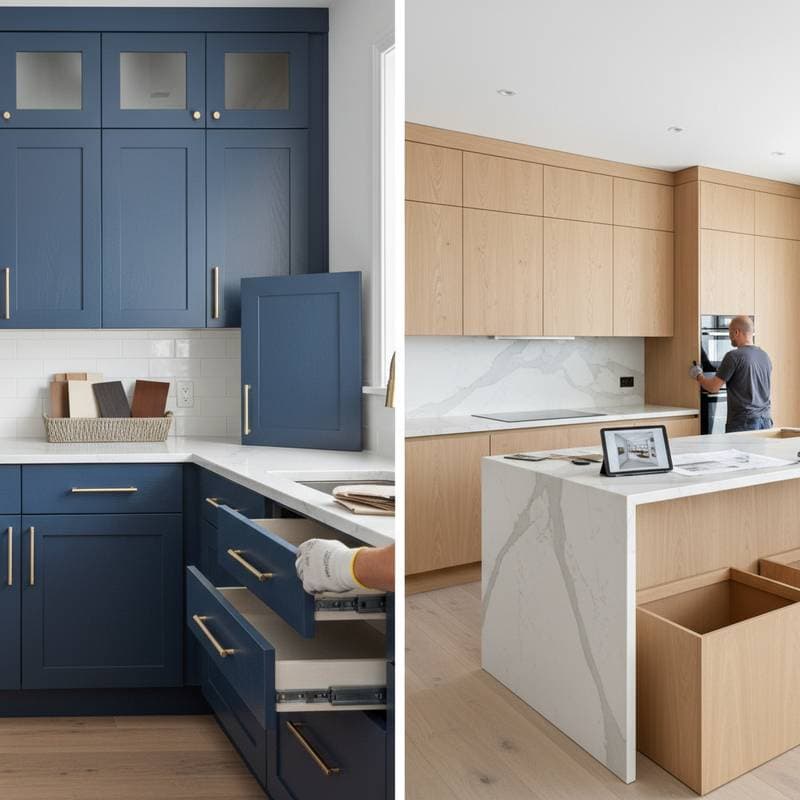
Reface or Replace? A Detailed Kitchen Cabinet Cost Analysis
Consider the instant when you open your kitchen cabinets and ponder if a new layer of paint might resolve the issues. Upon closer inspection, the doors hang unevenly, hinges creak persistently, and shelves bear the weight of countless stored items. At that point, the decision arises: should you reface or replace the kitchen cabinets?
The choice appears straightforward, yet the financial gap between refacing and replacement often spans thousands of dollars. Data from a national survey of homeowners reveals that only one-third of those planning a kitchen renovation complete the project within their initial budget. The majority exceed estimates, frequently due to on-the-spot choices regarding cabinetry.
This analysis examines those expenses with precise figures, enabling you to select an approach that aligns with your aesthetic goals and financial constraints.
Understanding Cabinet Refacing
Refacing involves updating the exterior appearance of existing cabinets while preserving the original structure. Technicians apply new veneer, doors, and hardware to the cabinet boxes, which must remain in sound condition without major structural damage.
This method provides a cost-effective way to modernize the kitchen without extensive alterations. It suits situations where the layout functions well, and the focus lies on visual enhancement rather than reconfiguration.
Average Cost Range for Refacing
Anticipate expenses of $150 to $400 per linear foot for refacing, translating to $5,000 to $15,000 for an average-sized kitchen. Factors such as material quality and kitchen dimensions influence the final amount.
Breakdown of refacing costs:
- Basic veneer and doors: $100 to $200 per linear foot
- Mid-range options with hardware: $200 to $300 per linear foot
- Premium finishes: $300 to $400 per linear foot
- Labor for application: $1,500 to $4,000
- Minimal demolition: $200 to $800
Mark Ellison, contractor and owner of BuildRight Renovations, notes that refacing proceeds more swiftly than full replacement. "Refacing avoids major disruptions to plumbing or electrical systems, keeping additional expenses low," Ellison explains.
Exploring Full Cabinet Replacement
Full replacement entails the complete removal of old cabinets, followed by the installation of new units. This process permits a total redesign of the kitchen layout, offering maximum flexibility in design.
While it demands the largest investment, replacement ensures modern features and superior durability. Homeowners select this option when seeking comprehensive improvements beyond mere aesthetics.
Average Cost Range for Replacement
Budget $300 to $850 per linear foot for standard new cabinets, resulting in $15,000 to $30,000 for a typical mid-range kitchen. Custom high-end cabinetry frequently exceeds $40,000.
Cost components for replacement:
- Stock cabinets: $100 to $250 per linear foot
- Semi-custom cabinets: $250 to $550 per linear foot
- Custom cabinets: $600 to $850 per linear foot
- Installation labor: $3,000 to $8,000
- Demolition and disposal: $500 to $2,000
According to Mark Ellison, installation for replacement often doubles the duration of refacing projects. "Full replacement usually requires adjustments to plumbing and electrical elements, particularly with layout changes," Ellison states. "Such modifications introduce unforeseen costs."
Evaluating Return on Investment
Return on investment proves essential, particularly for homeowners intending to sell within several years.
Refacing generally recovers 60 to 70 percent of its cost upon resale. Replacement achieves 70 to 80 percent recovery, especially when combined with updates to countertops and appliances.
The margin between the two options diminishes when considering project duration, household disruption, and initial outlay. If the existing cabinet boxes consist of solid wood and maintain structural integrity, refacing delivers comparable resale advantages at a fraction of the expense.
Janet Morales, real estate agent with GreenLeaf Realty, frequently recommends refacing to sellers. "Buyers perceive the kitchen's overall ambiance rather than the underlying cabinet construction," Morales observes. "A well-executed refacing can appear entirely new to most observers."
Scenarios Favoring Replacement
Opt for replacement when the current kitchen layout proves inefficient or the cabinet boxes suffer damage.
Select replacement under these conditions:
- Significant layout modifications are desired.
- Existing cabinets feature particleboard or exhibit swelling from moisture exposure.
- Long-term residency in the home calls for complete customization.
- The project coincides with extensive renovations, such as new flooring or relocated plumbing.
Replacement facilitates additions like deeper drawers, pull-out organizers, and ceiling-height upper cabinets. These elements enhance storage capacity and boost market appeal.
Michael Trent, certified remodeling consultant at BudgetSmart Renovations, emphasizes functionality's importance. "Replacement allows correction of everyday inconveniences that accumulate over time," Trent advises. "The value extends beyond mere resale potential."
Project Timelines and Household Impact
Refacing projects conclude in three to five days, minimizing interference with daily routines.
Replacement extends from two to four weeks, encompassing demolition, material delivery, and installation phases. During this period, the kitchen often becomes nonfunctional, at least partially.
For those working remotely or managing compact living spaces, such interruptions carry significant weight. Refacing offers a quieter, less dusty alternative with reduced tool usage and no appliance relocation. Busy households often value this efficiency as highly as the monetary savings.
Sustainability Considerations
Full cabinet replacement produces substantial waste, as large wooden components resist easy recycling and contribute to landfill accumulation.
Refacing preserves the core structure, slashing waste output considerably. Many choose this path for its environmental benefits.
Certain providers repurpose hardware or utilize sustainable veneers. Inquire about low-VOC adhesives and finishes from contractors; these options incur a modest premium yet enhance indoor air quality.
Effective Budgeting Strategies
Establish your financial framework before delving into design inspirations.
- Define a total budget ceiling. Allocate at least 15 percent for unexpected costs.
- Obtain three detailed estimates. Ensure each covers materials, labor, and disposal.
- Inquire about schedules. Expedited timelines may elevate fees but curtail disruptions faster.
- Verify contractor references. Skilled labor equals the importance of quality materials.
- Review warranty terms. Refaced elements might offer limited coverage, whereas new cabinets provide extended protection.
Secure a comprehensive contract outlining payment terms, project scope, and cleanup duties. Standard practice involves a 30 to 40 percent initial deposit, with balance payments tied to progress milestones or final completion.
Achieving Your Kitchen Vision
The optimal path—refacing or replacement—hinges on your kitchen's current state, available funds, and willingness to endure project upheaval. Refacing yields a refined upgrade with reduced expenditure and minimal disorder. Replacement provides a fresh foundation for enduring performance, albeit with greater investment and extended timelines.
For long-term dwellers, replacement streamlines daily tasks and elevates home equity. Those seeking aesthetic renewal without extensive turmoil find refacing a prudent, value-driven solution.